
How POS and Business Management Software Helps Snooker Clubs Track Sales, Revenue and Expenses
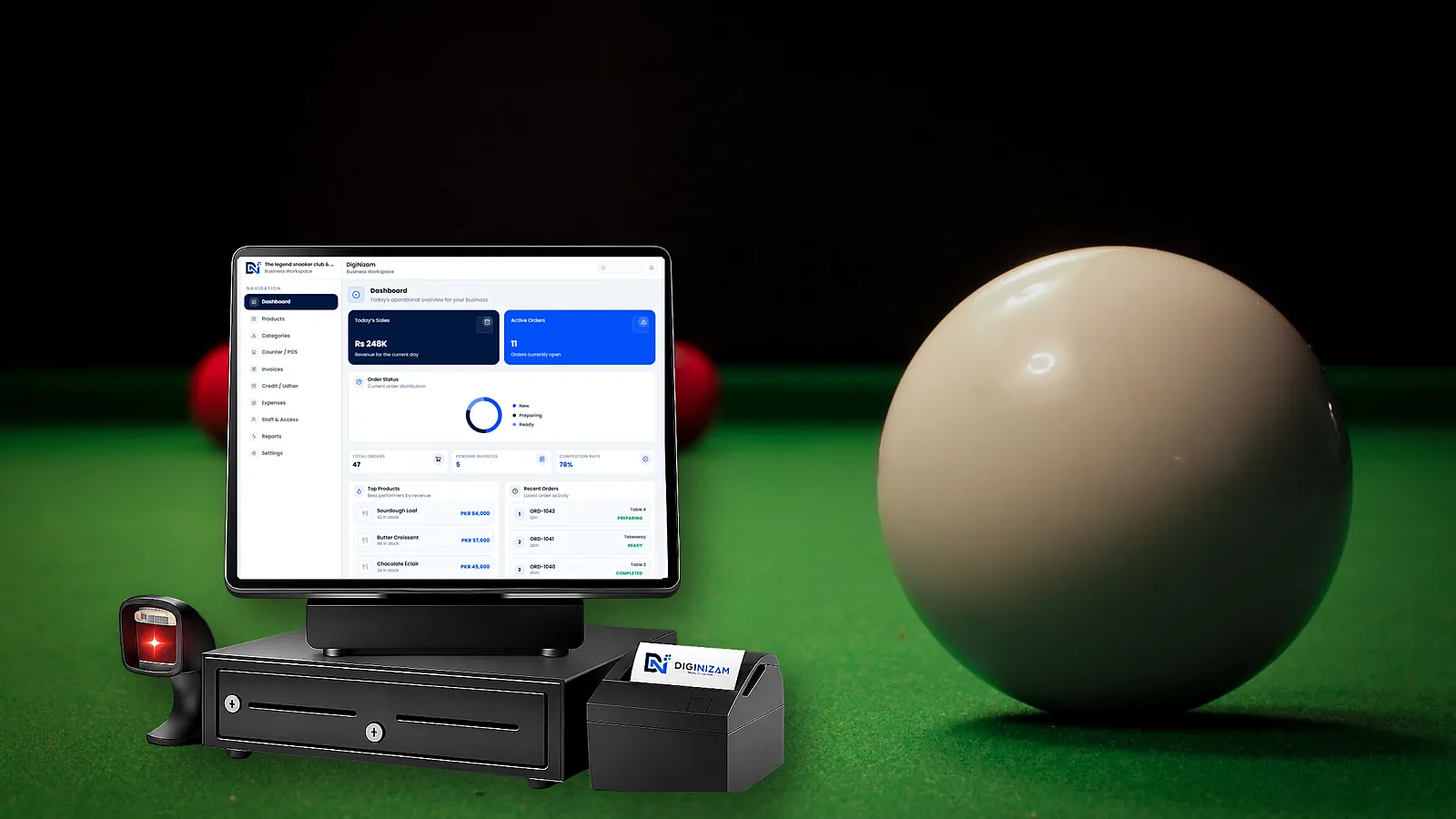
POS and business management software helps a snooker club track money by recording every table session, snack or drink sale, discount, credit balance and expense in one system. The owner can then reconcile cash each day and see revenue, costs and profit by table, staff member and branch.
Many clubs know roughly what they take in a night. Fewer know what each table earns, how much is owed on credit, or whether this month's electricity and repairs left a profit. This guide shows how to build that picture, step by step.
What should a snooker club track?
A snooker club should track each revenue stream separately, plus every cost that keeps the tables open. Mixing table time, snack sales and credit in one total hides which part of the business is working.
| Stream | Where it comes from | What to record |
|---|---|---|
| Table revenue | Fixed-price games and timed sessions | Table, game type, duration, rate, discount, payment |
| Food and drink sales | Snacks, soft drinks, tea and similar items | Item, quantity, price, stock movement |
| Credit sales | Regulars who play now and pay later | Customer, amount, balance, repayments |
| Discounts | Offers and goodwill reductions | Amount, reason, who approved it |
| Expenses | Rent, salaries, electricity, repairs, cleaning, cloth and equipment | Category, amount, date, approval |
Keeping table time, food and drink, and other income in separate streams lets each be judged on its own margin.
How does table revenue move from the table to the report?
Table revenue should be recorded once, at the table, and reused everywhere else. When the session is the source of the sale, nobody needs to retype it into a cash book or spreadsheet.
- A session is started on a table with its game type and rate.
- The session ends and the bill is calculated by the club's rules.
- Any discount is applied with a reason.
- Payment is recorded as cash, or added to the customer's credit balance.
- The sale appears in the daily close, then in daily, monthly, table, staff and branch reports.
How sessions, timers and rates work is covered in how to manage snooker table sessions, timing and bookings.
How do you track food and drink sales alongside table time?
Put snacks and drinks on the same bill as the table session, and keep each item as a product with its own stock record. One bill means one payment record, and product records show what sold and what needs reordering.
- Add items to the session so players settle the table and the snacks together.
- Record deliveries when stock arrives, not only when it sells.
- Count stock regularly and investigate differences before adjusting balances.
- Review margins. A drink that sells well but costs almost as much as its price adds little profit.
Some systems handle table time well but snack and drink stock poorly, so test both sides in any demo.
How do you track revenue per snooker table?
Revenue per table is the table revenue earned by one table in a period. Revenue per available table-hour divides total table revenue by the hours the tables could have been played: tables × opening hours × days open.
Example, in currency units: a club has 6 tables, opens 10 hours a day and trades 30 days. That is 6 × 10 × 30 = 1,800 available table-hours. If table revenue for the month is 90,000, revenue per available table-hour is 90,000 ÷ 1,800 = 50.
Now compare tables. If Table 1 earned 21,000 and Table 6 earned 9,000 in the same month, Table 6 may need repair, better placement or an off-peak offer. Revenue per table turns a feeling into a decision.
Which expenses should a snooker club record?
A snooker club should record every cost of keeping tables playable and the doors open, in consistent categories, as soon as it is paid. Monthly totals assembled from memory miss small, frequent costs.
| Category | Examples | Tip |
|---|---|---|
| Premises | Rent, service charges | Record on the payment date |
| Staff | Salaries, overtime | Separate by role or shift if useful |
| Utilities | Electricity, water, internet | Long opening hours make lighting a large cost |
| Table upkeep | Cloth, cushions, balls, cues, levelling | Note which table, to see cost per table |
| Cleaning and repairs | Cleaning supplies, fixtures, air conditioning | Approve larger repairs before payment |
| Stock purchases | Snacks and drinks for resale | Match to deliveries received |
Recording the table on maintenance expenses lets you compare each table's revenue with its upkeep.
How should a snooker club close the day?
A snooker club should close the day by comparing the cash the system expects with the cash actually counted, then recording any difference with a reason and a manager's approval. Doing this daily catches errors while the shift still remembers what happened.
- Open with a known float. Record the opening cash and the cashier at the start of the business day.
- Record cash movements. Log any cash paid out of the drawer, such as a small repair, as an expense.
- Count before looking. Count the drawer before viewing the expected total, a practice known as blind closing.
- Compare and explain. Expected cash is the opening float plus cash sales, minus cash paid out. Record any variance and its likely cause.
- Approve and keep the record. A manager signs off the close, and the record stays with the day's sales.
Track variances per cashier over time. Repeated overs deserve as much attention as shortages.
How should a snooker club manage customer credit?
Credit sales are revenue that has not yet become cash, so they need their own balance per customer. Without one, a club can look profitable on paper while cash runs short.
- Set a credit limit for each regular and record it.
- Add each unpaid session to the customer's balance, not to a loose note.
- Record partial repayments as they arrive.
- Review outstanding balances weekly and share statements with customers.
Which reports show whether the club is profitable?
Five reports answer most owner questions. Review some daily and the rest monthly.
| Report | Question it answers | Review |
|---|---|---|
| Daily sales and close | Did today's cash match what was sold? | Daily |
| Sales by table | Which tables earn the most and least? | Weekly |
| Discounts and credit | How much was given away or is still owed? | Weekly |
| Expenses by category | Where is money going? | Monthly |
| Profit | Revenue minus costs: is the club making money? | Monthly |
For multi-branch clubs, the same reports by branch show which location needs attention.
Example: a month-end review
In currency units, a club's month shows table revenue of 90,000 and snack and drink sales of 12,000, with stock costing 7,000. Expenses for rent, staff, electricity and table upkeep total 70,000.
Profit is 90,000 + 12,000 − 7,000 − 70,000 = 25,000. The table report shows Table 6 earning far less than the rest, and the expense report shows a cloth replacement on that table. The owner now knows what to fix and what it cost.
How DigiNizam helps snooker clubs track money
DigiNizam is business management software for snooker clubs. Its snooker club software records the session, the bill and the payment together, then feeds the reports owners rely on.
- Sales and billing: Single Game, Double Game and timed Century sessions, discounts with reasons and approval limits, and receipts.
- Customers and credit: credit sales with limits, partial payments, recoveries and statements.
- Expenses: categorised expenses such as rent, salaries, electricity, repairs and cleaning, with approval.
- Cash control: daily opening with opening cash and daily closing with expected versus actual cash, variance and manager approval.
- Reports and dashboard: sales, profit, expenses, credit, discounts, cash flow, tables, staff, branches and audit reports.
- Products and inventory: product records and stock movements across DigiNizam's platform features. Confirm how snacks and drinks are set up for your club during the demo.
DigiNizam does not offer online payment integration. Sessions are settled in cash or added to the customer's credit balance; if you take card payments on a separate terminal, confirm in the demo how they are recorded. Read how pricing is agreed and, for the bigger picture, what snooker club management software is.
Frequently asked questions
Is a credit sale counted as revenue?
A credit sale is revenue when the game is played, but it is not cash until the customer pays. Track credit balances separately so the daily cash close and the sales report both stay accurate.
How often should a snooker club reconcile cash?
At the end of every business day, and at every shift change if more than one cashier uses the drawer. Daily closing catches mistakes while staff still remember the details.
Can one system record table time and snack sales?
Yes. A club management system can put table sessions and products on the same bill and track stock for the products. Ask any vendor, including DigiNizam, to demonstrate both on one receipt.
Does DigiNizam process card payments?
No. DigiNizam does not offer online payment integration. Sessions are settled in cash or added to a customer's credit balance; confirm during the demo how payments taken on a separate card terminal are recorded.
See your club's numbers in one place
Bring last month's sales, expenses and a typical credit customer to a DigiNizam demo. The team will show how sessions, snacks and drinks, credit, expenses and daily closing come together in reports for your club. Pricing is agreed after the demo once your requirements are clear.
Book a demo